Friday, May 5, 2017

Sage Dynamics Vehicle Defense 2-Day AAR

"If you drive a panel van for work, get a new job." - Aaron Cowan

Nine months ago I took a two day defensive handgun class from Aaron Cowan at Sage Dynamics.  I walked away from that experience humbled and with a new outlook on firearms training.  I unconsciously approached that class with a "gun-tainment" mindset.  Coming from shooting exclusively at indoor ranges,  I was so excited to be able to shoot at multiple targets at speed, "temple index", and generally run around and do "cool ninja s**t".  I failed to seriously apply the techniques we were instructed.  "Hello, my name is Earl, and I am a ballistic masterbater."

After that I took defensive shooting more seriously.  I tripled my range and dryfire practice, and started hitting the gym.  I also decided that I needed training for events that were more likely to occur and to work my way up to more exotic classes like night vision and such.  One class that popped up was Sage Dynamic's Vehicle Defense.  Most of us spend a lot of time in and around cars.  It only makes sense to get some training involving one of the most common objects we all encounter on a daily basis.
Day 1: ~500 rounds

 The forecast was hot and sunny on day one, and called for rain on day two.  I came much better prepared this time around.  I brought a larger cooler, stocked with an entire case of water, Gatorade, food, and snacks.  I bought two trauma kits and a basic first-aid kit due to glass and sharp metal concerns.  1000 rounds of ammo, 200 rounds of defensive ammo, extra mag pouches, holsters, and two guns, an RMR'd Glock26 and an iron-sighted Glock19.  I chose to run my G19 without an RMR for two reasons.  First, I wanted the practice with irons, and after breaking my glasses a week earlier, I realized that I couldn't rely on the RMR if my glasses were knocked off in a fight.  Second, while I'm proficient with my RMR'd Glocks on the range, in training and real-life, I'll probably find myself in an awkward position, where my shoulders aren't square to the target with a perfect two-hand grip.  In those cases, I have trouble finding the dot and end up looking for the front iron sight.

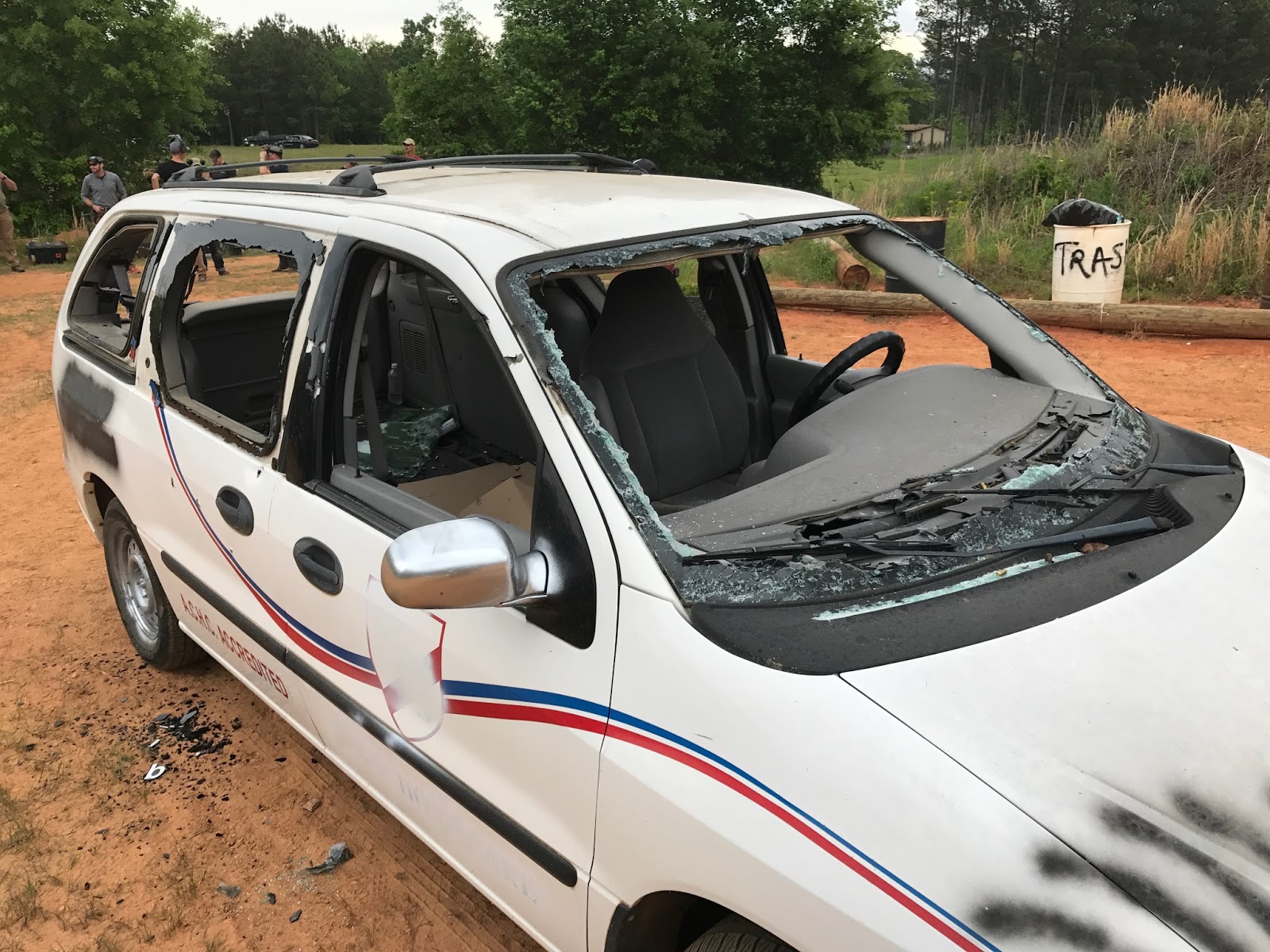
The class arrived on the first day at around 8:00 am.  I was surprised by the number of students.  There were about 20 of us, from all walks of life.  Two SWAT officers, former/active military, and even a group of guys having their bachelor party/weekend.  Aaron gathered the class and did his safety/medical briefing after which we positioned the cars and began the ballistic lesson.  The vehicles used for the class were a fullsize panel van, minivan, and midsize sedan.  The vans were provided by a Sage alumni.  Students were instructed to load their guns with their preferred defensive ammo.  Each student would then be told to shoot 5 rounds into different areas of the vehicle body.  After each student, we would gather around the vehicle and look for rounds penetrating and/or deflecting into and/or through the body/glass.  9mm, .40, .45, 5.56, .308, 7.62x39, and 12 gauge slugs/00 buckshot were used on all three vehicle types. This portion of the class was the most eye opening.  I assumed that handgun and 5.56 rounds would easily pass through both sides of a car when shot through the doors.  Only a few handgun and some of the 5.56 rounds made it out the opposite door unless they deflected through the window.  308 and AK rounds on the other hand passed through, though often they keyholed on exit.

We then broke into pairs, and shot five rounds through the windshields from the front seats.  We were instructed to not change our point of aim on the target to observe how our first few rounds deflect.  With the targets about 10 feet away, my first two Ranger 147gr rounds deflected about 3" from POA.  The subsequent shots were on target.  It highlighted the importance of fighting the urge to move to a clear portion of the windshield.  By shooting through the "milk" and burning a hole through the glass, accurate hits can be made through laminated glass.  Obviously, if the target moves, you have to track it, but the point was made.  After every student had done a run in each vehicle, Aaron moved onto the next lesson.  This was the pulse of the class.  10-20 minutes of instruction followed by shooting.  We were instructed on dealing with seatbelts, doors, glass, exiting, moving, and fighting in and around the vehicle.  We used the knowledge we picked up during the ballistics portion, to position as much cover between us and the threat.  Stacking the A pillar and C pillar between yourself and the threat can provide temporary but not insignificant cover.  Each lesson built on the previous one.  We learned the importance of proper metering off the vehicle, and why it's not optimal to suck up to the car and get as close as possible to the body.  Drills included engaging threats in front of and to the sides of the vehicle, then exiting and finding positions of cover or advantage.  We then moved on to scenarios.  In all scenarios, the assumption was that you couldn't simply drive away, or just run over the threat.  After each drill or scenario, each student marked their hits on the targets.  We were all held accountable for our accuracy.

The last segment of the the day involved defense of a third party.  As both the driver and passenger, we rotated through each vehicle with no-shoots playing the part of the wife/friend/child etc.  We learned how to safely draw and maneuver our firearm inside the cabin.  After running the drills solo, we paired up and did each drill again.  I noticed the level of concentration in the class ratchet up during this portion.  With a live person next to me, I fired fewer rounds, focusing harder on my accuracy and muzzle awareness.  I burned through almost three magazines with a cardboard goodguy, but with a live partner, I only needed a single reload.  That was my ah-ha moment for the day.  I was heading down the road of gun-tainment.  We ran the drills in the panel van and the sedan since the minivan didn't have a passenger seat, engaging threats while guiding the third party to a position of cover.

We finished the day with a funeral for the panel van.  We all hated the van.  Its size and lack of windows meant it presented us with few options to engage threats, and we also knew that most of the large body was thin sheet metal, offering very little ballistic protection.  We lined up and fired our duty/carry handguns, rifles, and shotguns into the van.  Most of the rounds penetrated out the other side.  Observing the problems the van was causing, Aaron quipped, "If you drive a panel van for work, get a new job."

Back at the hotel, I downloaded my GoPro video and watched my runs.  I noticed a lot of mistakes, though in many cases I self corrected during the run.  I would punch my gun through a window opening where glass would still be, meter way to close to the car, or punch my gun out over the hood or trunk.  After a shot or two, I'd back up, correcting my mistake.  I also noticed that I would shoot faster after a slide-lock reload, as if to compensate for the lull in gunfire.  I then spent an hour practicing my dry-fire and reloads until meeting up with a few of the students at the only nearby chain restaurant.  We talked jobs, guns, families, cars, politics, and the class before heading back.

One takeaway I had was how I didn't feel disadvantaged without my RMR.  Contorting around the vehicle cabins, and often shooting one handed, I was picking up my irons much more quickly than I would have my RMR dot, and getting good hits.  It also reinforced my belief that Aaron is a great teacher.  Some students shot no-shoot targets.  He didn't have to call anyone out or make a big show of it since everyone already knew it.  After one of my runs, he told me that I had strayed too far from the car to get a shot on my threat, and exposed myself to the second threat.  Instead of using it as a teaching moment for the entire class, he addressed me individually.  It was the same when a student violated a safety rule.  He made no attempt to hide it from the class to spare the students feelings, but simply addressed the issue with him and moved on.  It shows a level of respect for us as students, and a stark contrast from the instructors who treat classes more like reality TV.


Day 2:  ~350 rounds

I wish I'd brought my EZ Up.  The forecast had changed from light rain in the late afternoon, to heavy rain all day after lunch.  We removed all the glass from the cars and hammered down any metal protrusions as best we could.  We started the day with a practical quiz of the previous day.  The student started in the sedan and would engage targets around both vans at a simulated intersection.  We ran the drill solo.  Even though the threats and no-shoots were in the same position for each student, we often approached the drill differently.  I advanced toward the last van, while some students stayed behind the sedan.  Neither strategy is wrong.  If you have small kids strapped into car seats, you need to move the fight away from them as soon as possible while being as violent as possible.  If alone, stacking the car between yourself and the threats and looking for an escape route might be a smarter option.  Students could also retrieve a long gun from the trunk if they chose to.

We used 3D targets complete with cardboard arms that portrayed an empty hand, knife, or gun.  We then moved the cars into an ambush or road rage incident position.  The student started in the sedan with the panel van next to the driver side and the minivan blocking both cars at a 90 degree angle.  We ran the drill in pairs, with both students armed.  The key to the drill was simple communication.  No code words or abbreviations.  "Move to the back" "Okay move" "reloading" "Come back to me"  Simple and clear communication was critical especially around the van.  With limited sight lines, it was entirely possible for two students to end up on opposite sides shooting at a threat between them.  Fortunately, no safety violations occurred.

The scenarios started with students in the car with cardboard covering the windshield while everyone else moved the threat and no-shoot targets around.  There was no way to "game" the scenario.  When the cardboard was lifted, I saw a threat target standing directly in front of me.  I completely tunnel visioned on the threat as I drew my gun and failed to clear my backdrop, but a split second before I fired, I saw the minivan behind it.  I shifted my aim from the chest to the head to clear the van.  Two of my rounds impacted the roof of the van.  Directly behind the threat target, a student had positioned a no-shoot in the minivan.  We exited the vehicle and maneuvered around as a pair, engaged all the threats with zero hits on no-shoots, and checked our accuracy.  Then the rain came...hard.

We covered the targets with blue plastic trashbags, which meant checking for accuracy would prove difficult.  Other than that, we rolled on.  We ran more drills either solo or in pairs.  The last drill was a turkey shoot.  We would engage all targets from behind the panel van or sedan.  Aaron would call out positions to fight from.  Either over, through, or under the cars.  The rain stripped our guns of lube, and mixed with the Georgia clay, forming an unholy paste that gummed up a few guns, including a Glock.  Magazines that were buried in the mud were hastily rinsed off in muddy puddles and reloaded.  My G19 was feeling quite gritty but it ran just fine, until the front sight came loose.  Despite the sight flopping left to right, I fought through the drill, cursing myself for using blue instead of red loctite.  I finished the day with my RMR'd G26.  Despite the rain and mud, I was surprised at how I could still get hits with a fuzzy dot through a foggy lens.

By 4:00pm a creek had formed and there was no way were were going to be able to move the vehicles.  Aaron gathered the class and we headed into the barn for debrief.  I was cold, soaked, muddy, and tired.  Yet I had spent the day shooting so I was happier than a pig in s**t.  After the debrief came the infamous Sage patches.  Some students demonstrate excellent application of the skills learned in class and show up with solid shooting skills.  Aaron recognizes these students with a red pvc Sage patch.  One student received the coveted black patch for the top student.  I was one of six students to receive a red patch.


High fives and handshakes went around as the class broke up and headed out.  At home, I reviewed my GoPro footage and reflected on the past 48 hours.  I felt so much better this time around.  I learned a ton of new info.  I learned that I didn't have to feel out gunned without an RMR.  I can CCW a G19 with a weapon light.  My carry ammo does pretty well against vehicle bodies and glass.  Gym time is just as important as range time.

If I could do anything different, I would improve my first-aid kit.  Two students lacerated their thumbs but all I had were band-aids, gauze, and tape.  Some dermabond or steri-strips would have been handy.  Also, Red loctite on my front sight and an EZ Up.


Wednesday, April 5, 2017

Apex, Agency, and Overwatch Precision Tac Triggers

Here are some quick observations  on the Agency Arms, Apex, and Overwatch Precision TAC triggers for Glock handguns.  In this test I used my Gen4 Glock 19.  All springs are stock.  All triggers were used with an OEM "minus" connector.  All triggers came with a Gen3 trigger bar.  I measured the trigger pull weights with a Lyman Digital Trigger Pull Gauge.  Below are the averages of 10 pulls.  Due to the flat profile of each trigger, it was impossible to consistently pull from the center of the trigger.  I pulled the triggers parallel to the slide from the "hook" at the bottom of each trigger.  Since this is at a point lower than where your finger would actually rest, the readings are about 10oz lighter than you would actually feel.  For reference, I measured my HK VP9 at 4 lbs 14oz.

Apex - 4 lbs 0.3 oz

Agency - 4 lbs 4.7 oz

Overwatch Precision Tac - 4 lbs 4.1 oz

Next I measured total trigger pull distance.  I've seen people try to measure take-up and reset but short of a Dvorak TriggerScan, there's really no way to accurately measure every stage of a trigger pull.  The Apex was installed in my G19 Gen4 training gun, the Agency in my EDC G26 Gen4, and the Tac in my EDC G19 Gen4.  All have Ghost 3.5 Evo connectors, Vickers Mag Releases, and Vickers Slide Stops.  All other internal parts are stock.  The Ghost connectors have fitted over-travel stops so each of these represents the shortest distance I could achieve without sacrificing reliable ignition.

G19 - Apex - ~9.5mm

G26 - Agency Arms - ~5.5 mm

G19 - Overwatch Precision Tac - ~6.5 mm

Each trigger has it's stengths and drawbacks.  The Apex uses mechanical advantage to reduce pull weight, but has 30-40% more travel than the Agency and Tac.  It also has the longest trigger reach.  I wear size L Mechanix and have no problem reaching the Apex trigger, but smaller handed individuals may want to look else where.

The Agency feels the most comfortable.  The edges of the trigger are more rounded and the "hook" at the bottom is more pronounced.  This raises your trigger finger slightly higher than the Apex or Tac.  The Agency also has the shortest trigger reach.

The Overwatch Precision Tac trigger is the smoothest.  The trigger bar is polished and NP3 coated resulting in a buttery smooth pull.  The less pronounced trigger "hook" meant I noticed my finger dragging on the trigger guard and the edges of the trigger are almost square.

All three trigger passed a "drop safety" test.  I used a cut-down slide plate from Ghost Inc and tried to press the trigger bar down with a 1/16'" punch to release the striker.  Neither of these triggers allowed the cruciform to move down in the trigger housing unless the trigger was pulled.

I have the most trigger time behind the Apex, followed by the Agency and the Tac.  I always liked long triggers on my 1911's and preferred longer trigger reaches on my double stack guns and rifles.  However, my trigger techniques has evolved to use the "inch worm" method and I now gravitate toward shorter triggers.  While the Agency and Tac are extremely close, I have to give the nod to the Agency.  All three are great for shooting one hole groups but at speed, the Agency is the easiest for me to shoot.  The trigger itself just feels nicer and the short pull and reset offset the slightly heavier weight.  

-Carry On


Friday, January 6, 2017

PTR 32P PDW 8.5" 7.62x39 Pistol

Just a few photos of my PTR 32P PDW.  It's an HK 91 clone chambered in 7.62x39.  I hoped this was a newer gen 2 with 5/8x24 muzzle threads so I could use a SureFire Socom muzzle brake for my 762-Mini suppressor. But it's the slightly older version with 15x1 threading so my only option was the SureFire Socom flash hider.  I milled a few pockets in the tines to cut down on the "ping" that plagues pronged muzzle devices.  I also found out that the welded-on section of picatinny rail is too high to co-witness my Primary Arms Micro Dot with the iron sights even with the lo-mount.  Now to wait for my tax stamp.


I replaced the 15x1 Surefire Flash Hider with a 15x1 to 5/8x24 thread adapter from Griffin Armament and added Surefire 7.62 Socom Muzzle Brake.  With such a short barrel, I prefer a brake to act as a sacrificial baffle to protect the suppressor.  The thread adapter adds roughly 3/4" to the barrel.  I also replaced the wobbly MP5 handguard with an HK53 length handguard from HKParts.net.  It's long enough to fill in the gap at the barrel trunnion and has much less slop.


Monday, December 19, 2016

Dark Angel Medical - Direct Action Response Training - Day 2 AAR

Well that was humbling.  I started our second day thinking I was ready to deal with any basic trauma situation like a rock star.  I was dead wrong.  We returned in the morning and our instructor, Ross Francis, went over any questions we thought up the night before.  He then continued with more PowerPoints.  Ross covered environmental injuries from heat, cold, envenomation, and burns.  We then covered techniques for moving a victim and triage for mass casualties.  He defined this as anytime patients exceed medical resources.  If you find yourself alone treating two car accident victims with a single medkit, you're in a mass casualty situation, and must triage accordingly.  Triage is kept deliberately simple for speed.  "30, 2, Can Do" allows you to assess a victim in a few seconds, and designate them as green, yellow, red, or black.  Our last lesson involved calling 911 and how to respond to arriving EMS.

"Bring a damn marker!"

Fair Weather Farms cotton gin barn converted to meeting hall
After lunch, we returned to find practice stations for many of the skills we learned. At the NPA station,  we practiced inserting a nasopharyngeal airway into a dummy and familiarized ourselves with the SWAT-T and SOFTT-W tourniquets.
NPA & Tourniquet Station
 At the wound packing station, we packed inert combat gauze into a small gunshot wound, gunshot wound with exit, and severe laceration.
Wound Packing with practice Combat Gauze
 The third station was for using Israeli, Olaes, and mini-compression bandages.  We crated slings with triangular bandages to treat arm and collarbone breaks, and used SAM splints to make a neck collar and general leg splint.
Bandages

Once the entire class had rotated through the practice stations, we spent the last 3 hours running scenarios.  Each one of us was given a scenario with another student role-playing as the victim.  I went first.  It took me about six minutes to complete what should have taken two at the most.  My victim was suffering from a gunshot to the upper leg.  I had the tourniquet applied in less than 30 seconds but soon after drew a blank.  I was completely overwhelmed, trying to recall everything we had learned all at once.  Ross reminded me to remember H.A.B.C.D.E. and figure out what step I was on.  My mind was swimming but I managed to assess the victim, check vitals, perform a blood sweep (albeit poorly), treat the wound, and expose the victim, before finally wrapping him in a mylar blanket.  By the end I was sweating and forcing myself to take slow breaths.  Fortunately, I was not alone.  Every single student, including the repeat students had the same problems I did.  As a spectator, it was easier to figure out what the injury was and the next step in care, without feeling the eyes of the entire class and instructor watching for mistakes.  It took one student forever to realize her victim had been bitten by a snake, and another misinterpreted the feedback from the victim and almost began CPR on a conscious patient.  Fortunately, none of us actually killed out patient.  We often forgot small but vital steps, like assessing level of consciousness, or remembering to periodically check pulse and capillary refill.  We finished the scenarios with triage.  Two students would arrive on scene, while the rest of us were, dead, dying, or injured.  It was chaotic trying to assess a dozen people, all with varying degrees of injury, then having to recall the triage classification of each victim afterward.  

Dark Angel Challenge Coin
"Life or Death"
Class concluded with a final lesson and short video.  We watched body cam footage of a soldier being treated after he had stepped on an IED that took off his right leg and sent shrapnel into the left.  We watched other soldiers apply two CAT tourniquets and make victim assessments while under fire.  I could sense the mindset of the class had changed since yesterday, including mine.  We were all following along, putting ourselves in that video, and mentally treating the victim.  Finally, Ross provided us with some additional resources to for continuing training, and some advise on dealing with the psychological aftermath of a stressful event.  After receiving my challenge coin, I shook a lot of hands, and spend the next four hours driving home with the radio off.  I silently reflected on the last two days.  I though about how little I knew on day one, how confident I was starting day two, and how much I realized I still didn't know and needed to practice by the end.  I played "what if" the rest of the way and evaluated my performance and gear.

If I could improve one thing about the class, it would be to make it three days.  I'd like to spend two days in class, learning and practicing skills, and then a full third day running scenarios.  My biggest takeaway is how quickly things can go bad.  A medkit in my car, even if I can get to it and back in 10 seconds, is still too far away to make much a difference before the victims condition goes south.  If the victim is me, I'm dead.  I'll be spending a lot of my ammo budget this year on tourniquets and Chito-Gauze.  I plan to sign up for another Dark Angel class in the next few years, to brush up on my knowledge, and learn of any new advancements in gear and techniques.  My wife however, will be signing up ASAP.

-Carry On

Saturday, December 17, 2016

Dark Angel Medical - Direct Action Response Training - Day 1 AAR

Go here http://darkangelmedical.com/training/ and sign up for a class.  I'll wait...  With that out of the way.  Holy s**t! We're only halfway through the class and I haven't done more than apply a tourniquet to my arms and legs but I'm spent.  The day started at 8:30am at a picturesque lakeside venue.
Fair Weather Farms in Monroe, GA
The class consisted of 15 men including myself and four women.  We were a mix of law enforcement, business owners, professionals both blue and white collar, a stay-at-home mom, and one full-time UGA student.  We spent a few minutes introducing ourselves.  I'd say about half were "gun guys", but a common theme among the students was to simply be able to provide help if the need should arise.  A few students had first hand experience with emergency situations that led them to specifically seek emergency medical training.  After signing the ubiquitous waiver, we then settled in for a steady stream of information.  Our instructor is Ross Francis.  He is a full-time instructor with Dark Angel Medical, served as a Navy Corpsman, and is also a paramedic. 

Our Instructor Ross Francis
I was allowed to take pictures of Ross and gear, but photos or video of the students or procedures is prohibited due to Opsec/Persec concerns.  He keeps the class moving along at a brisk, professional pace, but will quickly address any questions or concerns we have before moving to the next topic.  There are a LOT of topics.  The student manual is 148 pages of slides from the PowerPoint that Ross used for class.  He also utilized videos, some funny, some graphic, and some tragic, to underscore key points.
Student Materials

While 8+ hours of PowerPoint could easily be used in place of waterboarding,  Ross often inserts his own mix of "Fozzy Bear" humor, obscure movie references, and stories from personal experience to break up the slides.  For the first three hours, Ross covered mindset, situational awareness, and the bodys response to stress.  While this isn't a firearms class, a lot of the points he made can be applied to self defense and firearms.  We then learned about critical anatomy and assessing the victims injuries and mental state.  After a 10 minute break, he moved onto to equipment.  Ross covered medical kit components, explaining the function and differences of each type.
Medkits and Components
Until today I didn't really know the difference between a dressing and a bandage.  He explained gloves, pressure bandages, hemostatic agents, tourniquets, and the emergency blanket.  You wouldn't think a mylar blanket would be considered very important compared to TQ's and QuikClot, but we learned that blood loss, equates to loss of body heat, which slows down bloods ability to clot.  More on clotting agents later.  Since day one is all classroom, we did not practice applying any of these devices, just when, where, how, and why we use them.  We go hands-on tomorrow.  One exception is the tourniquet.  Each of us was provided with a bright orange CAT-T.  We were shown how to stage the tourniquet for one-handed deployment on our arms and legs.  Periodically throughout the class, Ross would randomly yell out left/right arm/leg.  We then had 30 seconds to get our tourniquets on.  We didn't just loosely strap them on either.  We had to get them tight enough to no have a radial pulse.  If you do it right, it hurts...a lot.

Tourniquet Right Arm

Tourniquet Left Leg
Contrary to what some people think, a tourniquet will NOT automatically result in the loss of a limb, proven by the fact that I was able to drive back to the hotel and type this up.  Properly applied, a patient is in no additional danger of losing a limb for hours after a tourniquet is used.  Obviously there are situations where you cannot apply a tourniquet such as the neck or abdomen.  We also spent a lot of time on hemostatic agents, mainly QuikClot and Celox, and why gauze is better than granules.  Ross cleared up some misconceptions about them, but also cautioned us about older "Zeolite" based agents.  These heat up in contact with tissue sometimes resulting in 3rd degree burns at the wound site.  Also, other than their intended use, tampons are only good for minor nosebleeds.  Not gunshot wounds!  Around noon we broke for lunch, but not before watching combat gauze being packed into an arterial bleed in a pig.

One catchy mantra is, "stop the bleeding, start the breathing".  After lunch, we dove into the second part of that statement.  We covered airway, breathing, applying occlusive devices for chest wounds, why we should keep duct tape and safety pins in our medkit, and nasal airway tubes.  Around 3:00pm the room became even more serious when we moved onto specific injuries and treatment.  While I'm not particularly squeamish, some of the material is hard to watch.  One particularly unsettling video showed a loss of consciousness within 15 seconds of a hit to the femoral artery.  We got our tourniquets on a lot faster after that.  Photos of real wounds are displayed in full detail.  Gunshots, stab wounds, lacerations, amputations, facial injuries, compound fractures, and evisceration are fair game.  I'm glad I wear a silicone wedding ring after seeing examples of "degloving".  Unlike the gory photos we were shown in high school drivers-ed, the purpose is not to gross-out or shock us.  Most of us instinctively avoid or turn away at the sight of such things, but without seeing them, and having them explained and put into context, how would we be able to assess and treat them?  The last thing we went over was shock.  The big takeaway was to stop bleeding before the victim loses more than 750ml of blood, where survival rate is 94%.  Past 750-1500ml, it drops to 14%.  As with many things, speed is life.

Many of the lessons we learned are intertwined with each other.  Stress effects heart rate and breathing.  So does blood loss which reduces oxygen/glucose in the body, which in turn causes shock, which again effects heart rate and breathing, and so on.  Much of what we were taught is related, and Ross is always circling back to previous concepts as new ones are introduced.  He also constantly drills us to hammer home important points.  I'll probably never forget that an occlusive dressing is used on penetrating wounds between the collar bone and belly button, all the way around the torso,

At the close of day one, students who purchased them received their Gen3 medkit.  I don't operate operationally so I chose high-vis orange.  We we encouraged to take our ornage tourniquets home to practice with.  Apparently we'll be using them a lot more tomorrow so we better get good with them.
Dark Angel Gen3 D.A.R.K
Back at the hotel, I pulled the "trauma kits" from my car and took a close look armed with a ton of new info.  About a year ago, I purchased a $25 Elite First Aid, Inc. Tactical Trauma Kit and a $25 Adventure Medical Kits Trauma Pak with QuikClot.  When I signed up for this class a few months ago after listening to a podcast featuring Dark Angel founder Kerry Davis, I also purchased a Dark Angel Pocket D.A.R.K insert.  I also keep two CAT-Ts in the car.
Elite First Aid, Inc. Tactical Trauma Kit

Elite First Aid, Inc. Tactical Trauma Kit - Components
This is NOT a trauma kit.  The scissors might work once and the pouch and gauze pads seem okay, but nothing in it will stop a major bleed.  There's a "tourniquet" consisting of a 1" wide 18" long latex strip.  It could be useful in other ways, but it's all but useless as a tourniquet, and it's narrow width could cause nerve damage if employed as such.

Adventure Medical Kits Trauma Pak with QuikClot

Adventure Medical Kits Trauma Pak - Back
The Adventure Medical Trauma Pak seemed better since they make great first-aid kits and it contains QuikClot.  Again only the pads, gloves, bandages, and duct tape roll are worth keeping, but the QuikClot sponge is in the trash.  Here's why.


It's not 12' of gauze, it's a sponge.  Sponges are fine for non-life threatening wounds, but cannot really be packed into a wound site with an uncontrolled bleed.   It's also Zeolite based, which heats up in contact with tissue.  The label even says "product will feel warm in use".  It's gone.

Dark Angel Pocket D.A.R.K.
I did have enough sense to purchase the Pocket D.A.R.K.  I bought it specifically for the QuikClot Combat Gauze (Kaolin based, no heat generated) and SWAT tourniquet which is better suited for children, adults with small limbs, and even pets.  I shudder to think what would have happened if I tried to use any of this stuff prior to receiving training though.  My vehicle kit now consists of the Gen3 DARK and the red molle pouch with the boo-boo kit and Pocket DARK inside .  The Gen3 will come with me anytime I leave the car where its size isn't an issue, work, training, the range, etc.  I'll be purchasing additional Gen3's for my wife's minivan, the house and garage.  The Gen3 is a bit large for EDC, but a DARK Mini will remedy that.  I'll also be supplementing my kits with Chito-Gauze and Red Cross CPR face shields.  Of course, we still have to actually practice using it.

I started the day thinking I'd just learn how to use a medkit and sip from a fountain of knowledge.  Instead it was a fire hose.  Learning how to use the tourniquet in this class is like learning how to load a gun in a firearms class.  It's a single technique, and a tiny fraction of the skills and information you need to learn and practice.  We haven't even gotten to hands-on application, but already I feel a million times more prepared for an emergency.  While I may have fallen victim to the Dunning-Kruger effect, most of the concepts are kept very simple.  Keep blood in.  Keep them breathing.  One of Dark Angel's principles is after all: "simplicity under stress."  

-Carry On