Thursday, August 25, 2016

Glock Triggers Compared - Agency, Apex w/ Ghost Evo 3.5

Triggers, like most things, can be quite subjective.  While trigger pull weights and reset distances can be objectively measured, but it often comes down to personal preference when it comes to feel.  While I don't consider myself a trigger snob, I take a very critical look at triggers especially in my handguns.  The trigger is a critical interface to firing the gun.  It's that last thing that moves (hopefully) before the gun fires, and therefore can have a huge effect downrange.  An 8 pound rifle can have a 2 pound trigger, but a 2 pound handgun may have an 8 pound trigger.  Couple that with the fact that the rifle is stabilized by usually a minimum of 3 points of contact, and that we're more likely to have a handgun in a defensive situation than a long gun, and we can see why people get so wrapped around the axle about handgun triggers.

Anyone who says their Glock trigger is like a 1911 is either full of s**t or has never shot a 1911.  It can't by nature of the design.  The 1911 trigger slides back and forth, so it imparts zero vertical movement during it's rearward travel.  The shoe length can be tailored to your trigger finger so that it breaks when your finger is at exactly 90 degrees.  That means minimal horizontal movement as the shot breaks.  The Glock trigger moves in an arc.  Chances are, the break point is not at the point of the arc where vertical and horizontal movement are minimized.  I think this is why some people hate the Glock trigger.  It's not as short as a 1911, not as smooth as the double action of a Sig, and the trigger pulls are often inconsistent from shot to shot.  Weight can be adjusted with springs for the most part, and pre and over-travel can also be tuned out or simply ignored since they occur before and after the gun actually fires.

There's a  lot going on in the trigger stroke of a Glock.  The lack of smoothness is the result of a bunch of metal and plastic parts sliding into and against each other.  Ignoring the trigger safety, when you first pull the trigger, you can feel a slight bump as the trigger bar cam lobe hits the striker safety plunger.  The trigger bar lifts the plunger as it slides under it.  On Gen 4 Glocks, the trigger bar safety cam has a little bump on the side, which also rubs against the slide.  The second more pronounced bump is when the rear of the trigger bar first contacts the connector.  As you pull further, the end of the trigger bar slides down the connector rail until it drops far enough to clear the striker. During this last phase before firing, the trigger bar is now sliding against the safety plunger, connector rail, and down the striker hook.  We must also take into account the trigger pivoting on its pin, the sides of the trigger rotating against the locking block and slide stop, and the trigger bar sliding against areas in the receiver.  On top of that is the inconsistency due to three factors.  The trigger is plastic and flexes slightly as you pull it.  The trigger bar is doglegged around the magazine well, and also flexes and bows out a bit as it's pulled, pressing the side harder into the inside of the magazine well.  Finally, the slide rails are loose for reliability which lets it move vertically.  As the trigger bar slides down the striker, it actually pulls the striker and the slide down with it.  Without a magazine in the gun, you can actually observe the rear of the slide drop slightly as the trigger is pulled.  This drop increases the pull distance by a not insignificant margin.  With a full magazine loaded in the gun, the pressure of the top round is enough to hold the slide in it's highest position, allowing the shortest trigger pull. As the spring pressure decreases as rounds are fired, the friction of the trigger bar and striker can overcome the magazine spring and start to allow the slide to drop down.  I often wonder if this contributes to the "5th round flyer".

So, how do we address all these problems?  The simple answer is to practice.  Shooting and dryfire with eventually polish all the contact surfaces and 3k-5k rounds later, you should be quite proficient with the stock trigger.  That said, why not take advantage of any gear or products that can make our lives easier.  I'm NOT saying that gear is a shortcut to good practice, but it may help make that practice more efficient.  At a minimum, if you have a Glock with a serrated trigger such as a G19, I'd replace it with a Gen3 G17 trigger for around $15.  The smooth face is more comfortable than the serrated one and if you have a Gen4, the Gen3 trigger bar lacks a small bump on the striker block cam that smooths out the pull.  Do a 25 cent trigger job while you're at it.

Glock 17 Gen3 Trigger

Glock 17 Gen3 Trigger - Rest

Glock 17 Gen3 Trigger - Pulled

Glock 17 Gen3 Trigger

If you truly feel that the trigger is limiting your speed and accuracy, there are two triggers that I've tried that work to SAFELY clean-up the Glock trigger.  They are the Agency Arms Drop-In and the Apex Tactical Glock trigger with Ghost Evo 3.5 connector.  I used both during Sage Dynamics Defensive Handgun Fundamentals course.  On the first day I used the Agency.

The Agency trigger is damn impressive before you even shoot it.  The trigger is beautifully machined out of aluminum, eliminating the flex of the factory plastic unit.  The edges are rounded for comfort, but the face is flat with a small hook at the bottom.  The trigger safety is wider than the factory one and is also flat and made of aluminum.  The Agency logo is tastefully machined into the side.  Black was out of stock but I'm perfectly happy with "Agency Grey".It comes with a pre-installed Gen3 trigger bar that's been polished.  The rear where it contacts the striker has also been modified with a slight upward bend.  The purpose of this is to release the striker at the rearmost position of the trigger stroke.  The end result is a near elimination of over-travel.  Pre travel is taken care of by cutting the slot in the trigger for the trigger bar so that the trigger can only move forward enough to clear the trigger safety.  At this point, the cam for the striker block is just a hair away from touching the striker block, preserving the drop-safety.  The final piece is a polished factory minus connector.  All springs are left stock for reliability.  The pull is excellent.  There's no hint of the bump when the striker block is being raised.  If you really try you can feel when the trigger bar hits the connector, but it's subtle enough to miss.  The weight increases, stacking just a tough before the striker lets off.  There is a hint of over travel but it's there for a reason.  Remember how the slide can move down, effecting trigger pull distance?  The test is to pull up on the slide when dry firing, then repeating with the slide pushed down.  I've fitted some connectors where the striker wouldn't drop during the 2nd part of the test.  The Agency trigger passes.  Reset is textbook Glock.  What's the cost for an excellent drop-in trigger like this?  On top of the $150 msrp is the fact that the Agency moves the entire trigger press from start to finish about 1/4" further back in the trigger guard.  The angle it creates makes me feel like I'm pulling "up" on the trigger as it breaks.  Also the distance feels too close for me.  I have the same problem with any AR-15 with a standard A2 grip.  I really have to hook my finger in to break the shot.  I wear size large Mechanix gloves and have long fingers from years of guitar playing.  While the Glock's Gen4 backstraps would help increase the distance, they also make the grip too big for my palms.  For smaller or medium sized hands the Agency trigger might be just the ticket, but the reduced trigger reach is not ideal for me.  Also, the bottom of the trigger is open for the trigger safety.  This creates 2 sharp "fangs" that dig into my trigger finger pad during extended firing.  I had to consciously index my finger higher up on the trigger, but that might not be an option if you have big 'ol sausage fingers.

Agency Arms Trigger - "Fangs"

Agency Arms Trigger - Rest

Agency Arms Trigger - Pulled

Agency Arms Trigger
Stock Trigger Bar - Top
Agency Trigger Bar - Bottom


One the second day, I swapped the trigger with one from Apex Tactical and the Evo 3.5 connector from Ghost Inc that I fitted beforehand.  Like the Agency trigger, the Apex is aluminum and flat faced with a small hook on the bottom.  The aluminum trigger safety is narrower, but the bottom of the trigger is closed off.  No sharp "fangs" here.  I don't think it's nearly as nice to look at for what it's worth as the Agency.  The trigger is wider than both the Agency and the stock plastic trigger, so it can't be used in a G42/G43.  It reduces some pre-travel in the same manner as the Agency does, but not quite as much.  It reduced over-travel a bit over stock, but it was much more noticeable than the Agency.  More on that later.  You can get the the Apex trigger with or without a Gen3 trigger bar installed.  Save yourself the effort and get it with the trigger bar pre-installed.  The first time used the Apex was actually on my G26.  I re-used my Gen4 trigger bar which required drilling out a hole in the factory one.  DO NOT USE a Gen4 trigger bar with the Apex!  The Apex trigger sets the trigger bar a little further to the right than stock.  This has two effects.  First, the trigger bar is in a position to put more pressure on the inside of the magwell as it bows out during the trigger press.  Second, the nub on the Gen4 trigger bar gets wedged hard enough into the slide to prevent the trigger from resetting!  It also added what felt like 5 pounds to the weight and the feeling of dragging a brick across asphalt.  With the Gen3 bar installed, it was fine.  To nearly eliminate the over-travel, I fitted a Ghost Evo 3.5 connector.  It features an over-travel stop that must be filed down until the striker fires.  I filed and tested until the gun passed the dry-fire while pushing the slide down test.  Then I filled it a little more to be safe.  I also did a "25 cent trigger job", a step not required with the Agency.  I kept the stock springs for this trigger as well.  The pull is now similar to the Agency, albeit not quite as smooth, and with one critical difference.  It's farther forward in the trigger guard than stock.  For myself, the break point is spot on.  Even with a willfully bad trigger press, I noticed my red dot doesn't bounce completely out of the window like with the stock or Agency trigger.

Apex Trigger

Apex Trigger - Rest

Apex Trigger - Pulled

Apex Trigger - Wider than stock


So what's the verdict?  Which one allowed me to drop my split times and cut ragged holes in my targets?  Well, my performance was about the same on both training days with both triggers which was not high enough to earn the Red Sage patch.  I can't blame the trigger or any of my equipment for that.  It's proof that practice will always trump gear, and Lord knows I need to practice.  The Apex kit with trigger bar is $50 cheaper than the Agency, but I had to spend $45 on the Ghost connector to get it comparable.  Add in the time of fitting the connector and the price difference is a wash.  Both are excellent choices, but I think the decision comes down to hand size.  I put the Apex in my EDC Glock 19.  It just works better for my hand size and finger length.  I put the Agency in my home defense Glock 19. (31 round mag, weapon light, and suppressor)  My wife is more likely to use that gun and she preferred the shorter reach of the Agency.  For now, all my future Glocks will wear Apex triggers.  Now if Agency ever comes out with a longer reach version...

-Carry On

Update:

So after putting another 300 rounds through the Apex, a few more issues have surfaced.  One, you can't pull the trigger after it's reset if the gun is slightly out of battery.  The trigger safety hook is large enough that you can't really overcome it.  So instead of the dreaded "click", you simply get no movement in the trigger.  Second, I've been placing my finger higher on the trigger as I've found I shoot better that way, but sometimes, I don't get enough of the trigger safety and it hangs up.  It never prevents me from pulling the trigger, but it is annoying.  Also, while I at first liked the longer reach, now that I've gotten more trigger time, I think it's a little too long.  Finally, the front edges of the Apex trigger aren't as rounded as the Agency and just doesn't feel as nice.  So, I sacrificed a stock Gen3 trigger and relieved it of it's trigger bar, which I gave a nice polish.  I swapped the Gen3 trigger bar for the modified one in the Agency and installed it in my EDC G19.  I had to fit the trigger stop on the Ghost Evo 3.5 connector but the results are terrific.  The Agency trigger now starts in the same place as before, but breaks closer to where the factory trigger does with a "minus" connector.  There's just enough over-travel to pass the push-down-on the -slide-and dryfire test.  I've put 200 rounds downrange and I'm pretty happy with it so far.  I'm pretty close to putting this setup on all my other Glocks.

Agency Trigger, Stock Bar, Ghost Evo 3.5 Connector - Rest

Agency Trigger, Stock Bar, Ghost Evo 3.5 Connector - Pulled

Monday, August 15, 2016

Sage Dynamics Defensive Handgun I - Day 2

Well, I didn't earn the red patch.  At the end of the course, Aaron gives out a red pvc "Sage" patch to any student who demonstrate application of the training received at a high level.  I did not expect a red patch, especially after starting day 2.
Close Retention Shooting

This is my target after close retention shooting.  Aaron's standard of accuracy is a group just large enough to "throw a cat through" on the most vital regions of the target presented.  Only 4 of my high compression shots were in the vital region of the thoracic cavity,  My pelvic shots were a little too close to center instead of at the right pocket, and none of my three attempted head shot hit the brain stem.  While I used to consider these hits "combat effective", none would guarantee instant incapacitation.  The pace of Aaron's training forces you to pay attention.  Aaron would often begin a section with a real world example, usually an officer involved shooting.  He would identify the problem the officer faced, and then the outcome or possible solution.  This is not Monday morning quarterbacking.  This gave us the why, not just the how.  He would then demonstrate the technique, after which we would perform it once at our own pace.  The second or third time we would perform it at the highest speed possible while still delivering accurate fire.  The last time he often asked us to run it as fast as possible so we could see the difference between taking a little time to get a clean sight picture and pushing your performance envelope.  As it was humid and in the mid 90's, we took breaks between skill sessions often.  This was how the class went for the day.  We shot from the traditional prone and reverse-supine positions at 25 yards, and used "explosive movement" where we'd sprint 25 yards to the target, engage, sprint back, and then re-engage from 25 yards.  On my attempt I nearly tripped on my way back to the group.  "Running is easy, it's the stopping that's a bitch." - Cowan
Explosive Movement - Move! Temple Index

Explosive Movement - Engage Close Range

Explosive Movement - Run Back - Temple Index

Explosive Movement - Engage from 25 yards

We shot a simulated moving target in which 5 targets were positioned close together at progressing angles.  This allowed us to get a string of sight pictures as we swung to the right.
"Moving" Threat

"Moving" Threat - Torso

"Moving" Threat - Headshots

I had the most fun with solo judgement shooting.  5 targets were setup in close proximity, one armed.  The student had his back turned.  At the "look" command, we would turn around and search for the threat, then move to engage while ensuring our shots didn't hit the no-shoots.  The threat was moved for each student.
Close Proximity - 1 Threat, 4 No-Shoots - Work Angles
The next variation was 10 targets, spaced out with a single threat, then two threats. Each time we would reposition the targets so no student could know what they would be facing.  Aaron would use an auditory clue to start the exercise.  Anything from "He's got a gun", "Oh my GOD!", to "F--K You A--Hole!"  He explained that a beep from a shot timer is great for measuring speed, but does not take into account the time it takes to think through the problem.
I.D. Threat and Engage

Looking for additional threats

Working angles

Engage 2nd Threat

2 Threats - I.D. and Engage in order of importance

At the end of the day we debriefed.  Aaron encouraged us to share our knowledge with the caveat that we put it in context, not just say "do this because Cowan said so".  A few red patches were handed out including one coveted black patch.

Class Debrief

The "circle of guns" and an obligatory Instagram photo with a foot in it.
"Guns.  Lot's of guns."

"Get your foot out of the photo!"

On my drive home I went over the weekend in my head and came to a humbling conclusion.  I did not take the class seriously.  I was treating it more like "tactical fantasy camp" instead of training.  I was happy to get off the square range and get to practice cool stuff live moving and shooting fast.  I should have made a more conscious effort to apply what I'd been taught, to slow down and focus on getting incapacitating hits instead of "running and gunning"  My biggest take-away from this class is how much I need to work on.  I can often shoot tighter groups at longer distances than others at the indoor range, but that does not translate into real world skills.  It's the "Lake Wobegon Effect" of which I am a resident  I have a greater understanding of my limitations and a much more serious motivation to practice and get further training.

On a final note, like the instructor, every one of the students was exemplary.  Type-A guys (no ladies for some reason) who were above the stereotypical bravado and self indulgent narcissism of what you see on the internet.  Everyone was eager to share knowledge, stories, experience, and even food or equipment.  They were all simply a good group of guys, and I hope to see them again in future classes.  Above all else, I'm earning that patch.

-Carry On

Saturday, August 13, 2016

Sage Dynamics Defensive Handgun Fundamentals - Day 1

F**K North Carolina in August!  It was HOT.  Highs in the low 90's with humidity hovering around 70%.  I brought a small cooler with 6, 20oz bottles of water and 2, 12oz bottles of orange juice.  I was out by lunch.  Fortunately there were more experienced students who let me raid their Yeti.  I was the least experienced shooter.  Our class of 10 had 1 competition shooter, 6 instructors, and 3 like myself, what I'd call defensive minded citizens.  I arrived at 8:45.  People were milling about, loading magazines, shooting the breeze, and setting up equipment.  Speaking of equipment other than a stock XD and a lightly customized CZ 75,  every other student had an Agency Arms Glock.  Having never fondled one myself, I was impressed, and my "custom"(DIY) Glock 19 looked crude by comparison.  At 9:00am, Aaron addressed the class.  He introduced himself and went over the safety rules.  He has a common sense approach to range safety that are much more nuanced versions of the 4 safety rules we know and love.  He runs a "Hot" range.
Class Intro
Aaron paces the class very well.  He thoroughly dissects a topic, but doesn't spend any more time than he needs to on it.  In fact, the above photo is the only one I had time to get before the class started.  Being a fundamentals course, Aaron covered Grip, Sight Alignment, Sight Picture, Stance, and Trigger Control.  These topics have been discussed ad nauseam, but he has a way of breaking them down so they are not just easily understood, but easily applied.  An example was how he described gripping the gun like you're crushing a beer can.  Not just the pressure, but the application of force at each finger.  Once this "clicked" for me, I noticed my groups tightening up.  I still have to be conscious of my grip, but now I know what to work on at home.

Aaron stresses accuracy, but not precision shooting in the traditional sense.  He spent a good deal of time going over anatomy, mainly that which is critical for life function.  Instead of focusing on shooting tight 1 hole groups, Aaron strives for precise targeting of vital anatomy.  Not just head shots, but targeting specific regions of the brain that guarantee instant incapacitation.  Vital organs in the chest and certain regions of the pelvis were also described.  Since we are targeting specific regions inside of a 3 dimensional threat, we used 3D cardboard targets.  We would set them up facing directly toward us, from the side, and at various angles.  This acclimated us to points of aim that you can't replicate on a 2D target.  Later we attached cardboard arms depicting knives or handguns.

Being defensively minded, we began our shooting drills issuing verbal commands.  It felt silly at first, but after a few evolutions we found ourselves genuinely screaming at the cardboard target to "DROP THE KNIFE" or GET THE F**K BACK!  We were not told what to say, just suggestions to keep it simple and address the most important issue first ie:  If a guy with a knife is advancing from 25 feet away, "STOP, DROP THE KNIFE" would be prudent since he has to get closer to use the knife on you.

After lunch, we were introduced to the hot rocks that had been baking in the sun all day.  We shot from kneeling positions, moving to supine and fetal.  I'm glad I brought my knee pads.  We learned to fight as we recovered from the fetal, to supine, to kneeling, to standing positions.  A double stack handgun is especially handy for this, though even my 15 rounders were barely lasting through the drill.  17 or even 20 rounders are on my shopping list.

By 4pm I was beat.  While the drills aren't that physically demanding, the constant mental focus and especially the heat took their toll. Every time we stopped to top off our mags, everyone sucked down a bottle of water and had a handful of jerky, pretzels, chips, crackers, energy bars, etc.  Staying hydrated is critical to staving off mental fatigue in the heat, and a few bits of food to replenish electrolytes lost to sweat meant they were in much better condition to learn than I was.  It's nearly 10pm, and I still have a mild headache even after drinking nearly a gallon of water.  Tomorrow morning I will pick up a case of water, an 8 pack of Gatorade, and assorted snacks.

Sage Dynamics Defensive Handgun I - Day 2

Friday, August 12, 2016

Sage Dynamics Defensive Handgun Fundamentals Class Preview

My Training Background:

Or lack thereof.  I have zero law enforcement or military training.  I took the required NC CCW Course which consisted of 8 hours of classroom instruction and a 40 round qualification shoot in which we had to put at least 20 of the rounds anywhere on an NRA B-27 target at 15 feet.  I have attend a 4-hour pistol fundamentals course at Sig Academy that coincided with some business travel.  We mainly covered draws and reloads from the belt on steel targets at ranges from 5 to 15 yards.  I have also attended my local range's CCW classes.  These are 3-hour classes that are mostly like IDPA practice sessions.  IDPA cardboard targets, blue barrels as "cover", draws and reloads from concealment, close compression shooting, etc at an indoor range.  Not a bad deal for $75 and 100 rounds of ammo.  I don't consider any of these to be training so much as guided practice.

When I first started shooting 15 years ago, I had made it my mission to attend a weekend class at Gunsite and train with the late Jeff Cooper.  However with money and time in short supply I never got that chance before he passed.  However, my research into Gunsite and its founder led me to other professionals like Clint Smith, Chris Costa, and Travis Haley.  I learned what I could from their DVDs.  I enjoyed Smith's highly quotable "Clint-isms" and his KISS methods were grounded in reality.  Regarding tactical reloads: "Why am I taking the gun apart, that has already saved my life, and why am I going to start c*ck-juggling magazines with a heart rate of 160, 70, 80, and auditory exclusion and my eyes are watering and I've got my Mickey Mouse underwear and my Ho Chi Minh flip-flops on, I'm not exactly sure that I wanna be taking stuff apart."  My introduction to Chris Costa and Travis Haley were through Magpul's (I admit I am a Magpul fanboy) Art of the Defensive Handgun/Rifle/Shotgun DVD's  The common denominator of these guys was that they never demonstrated a technique with explaining the reasons for it.  They demonstrated more common but possibly less effective techniques and encouraged students to use what worked best for them.  Haley's rule to choose a technique that works 95% of the time and raise it to 99.99% is one that I incorporated into my practice.

Enter Aaron Cowan:

A few years back I stumbled upon a small YouTube channel while looking for gun videos.  I almost didn't make it past the first 10 seconds of the video.  A montage of highly modified handguns and AR-15's being prepped to heavy metal, the ubiquitous opening of a tacticool bro-tuber.  A heavily muscled man with a shaved head and sunglasses, and tattoos festooning his arms.  "Just another wannabe James Yeager", I thought, "God I hate the internet sometimes".  As I was about to click on the "one weird trick" to flatten my belly, he spoke.  I few hours later I had watched every video on the channel and was on the website looking for training classes in my area or near any locations I would be visiting.  My travel schedule would not allow it, so in the meantime, I eagerly waited for each new video.  I read the Hagakure.  I even bought his eBook, a novel about an assassin turned covert operative. Finally, the stars aligned this year.  I had a break in my travel schedule and the Defensive Handgun class was a few hours away.  More importantly, I got the okay from my wife.  I eagerly signed up and sent my payment.  I received an email a few days later with confirmation and a course packet, containing the course syllabus, location, and required and recommended equipment.  I sent a response email with a few questions regarding my front sight choice with an RMR, and my holster choice.  I received a response a few days later from the Sage himself.

In a few days I will be embarking to Carthage, NC for Sage Dynamic's 2-day defensive handgun course.  It is the only stop of Sage Dynamics in North Carolina each year, about 3 hours from my home near Charlotte.

What I'm bringing:

,A hopefully, unbiased and open mind.  On the gun side, I will bring 2, Glock 19's and 6, 15-round mags.  My primary is a 4th gen Glock 19 with a Unity Tactical Atom Slide, Trijicon RMR, Apex Trigger, and DIY frame mods.  Undercut, accelerator cuts, and stipple job.  My backup is another 4th Gen G19, with Agency Trigger, threaded barrel, rasied sights, and DIY stipple job.  I may also bring my G26.  Primary holster and mag carriers are from Guncraft.  Backup holster and mag carriers are form a small local outfit called Priority 1.  They are very simillar to Guncraft for about half the price and a 2-3 day lead time.  2 Ares Gear Aegis Belts, Vertex khakis I got on clearance, spare factory parts, cleaning kits, and 1000 rounds of Winchester bulk 9mm round out my gear.  I plan to run the class with all my EDC gear, Spyderco Delica 4, Streamlight Protac 1L-1AA, in CCW configuration.  Holsters and mags in the appendix position under t-shirt.  It's gonna be hot and humid as North Carolina summers often are with the constant threat of pop-up showers and t-storms.  Knowing that the intensity of this course will surpass anything I've done before I'm also packing a set of gloves and volleyball kneepads.  Ever slam your knee down on a shell casing?  I don't want to go at half speed or limp through the day just to hold onto my "man card".
Class Equipment Layout

Training Expectations and Goals:

I will be using this as an opportunity to learn as much as I can and find out how good I really am.  I consider myself a pretty good shooter, but without the crucible of a real, life threatening encounter, I have no reference other than how I perform in training under stress.  I hope to have a few myths or preconceptions dispelled, and finally to test and review my equipment choices.  I will have an after action review and report my equipment findings shortly after.  Until then...

-Carry On

Sage Dynamics Defensive Handgun Fundamentals - Day 1

Unity Tactical Atom Slide for 4th Gen Glock 19

This is my Glock.  There are many like it...
Glock 19, ATOM Slide, Trijicon RM06 

This is a difficult review to write.  It's less of a review as much as a story.  My experience with the Unity Tactical Atom slide has been a two-sided affair.  Do you like 1911's?  Do you enjoy patiently fitting and troubleshooting parts?  Can you fit a 1911 barrel?  Do you have a steady hand with a file and access to a mill or machine shop?  I do.  That's why even though it has been the most frustrating thing I've ever put on my Glock, I'm glad for the experience.

My EDC is a Gen4 Glock 19 MOS.  The trigger is from Apex, the connector a Ghost 3.5 Evo.  A Glockmeister grip plug, Vickers mag release, and OEM extended slide release round out the new parts.  All springs are factory weight.  I swapped the factory craptastic sights with a raised set from Dawson Precision.  I mounted my Burris Fastfire 3 on the slide with the provided adapter plate.  One 350 round range trip confirmed 2 things.  Glocks are boringly reliable, and I'm really starting to like the red dot.  I knew I'd need a lot of practice to be able to find the dot as quickly as my irons out of the holster, but the increased hit probability at 25 yards and speed of follow up shots past 7 yards made me realize the red dot would stay.  I had doubts about the Burris unit surviving an upcoming Sage Dynamics Handgun course.  Would it survive 1000+ rounds, being used to rack the slide one-handed.  I also noticed the rear sight kept grabbing my attention away from the target.  I thought about sending my other G19 slide to Agency Arms ($$$!) or AETI, but knew I would'nt get it back before the class.  I knew of the Unity Atom slide, but they were sold out at every online retailer.  Then I happened to find one on Gunbroker and jumped on it.
ATOM w/ RM07 - Front sight completely blended with background

On paper it sounds perfect.  17-4 stainless, interchangeable optic plates, a la MOS, rear sight forward of the optic, front serrations, raised sights, and the same weight as a factory slide with an RMR mounted.  When I received the slide all was right in the world.  I wanted black, knowing that the FDE finish would wear as badly as my FNX 45 Tactical, but since I planned to use this at a Sage Dynamics Handgun course, I knew that no pistol would come though without a few battle scars.  Plus FDE was all they had left.  The sights were perfectly centered.  My factory barrel and slide internals all went in without a hitch.  I installed the slide on the frame and pulled the slide to the rear.  It stayed back. Locked open about 1/4 inch from fully to the rear, stuck in both directions.  The slide stop was not engaged in the notch.  The slide was simply stuck.  There was no movement in the barrel either.  Shit.

I banged on the rear of the slide and it shot forward.  I removed the slide inspecting the barrel lugs and locking block for debris or wear.  There was nothing out of the ordinary.  The top of the slide however had a pronounced wear line on the front of the hood.  The barrel was not dropping down far enough and as the slide retracted, it was wedging the barrel between it and the locking block.  I tried the slide on my other non-MOS Glock 19, also a Gen 4 and the slide hung up but didn't get stuck.  It was plenty loose on my G26.  I tried swapping barrels, and locking blocks with the same results.  So either the slide was out of spec, or Glocks tolerances are looser than an 1973 MG.
Wear on barrel hood from contact with slide

I called Unity Tactical and described the problem.  They said the slide might be out of spec and I could send it to them.  The problem was, I had already sold my MOS slide to buy the Atom, so my RMR would be out of commission for the Sage Dynamics course in 2 weeks.  There also wasn't enough time to have my other G19 slide sent out for milling.  I decided to put my experience with building 1911's to the test.  I broke out the calipers and took some measurements.  The top of the Atom slide was 0.012" thicker than the Glock slide.  I popped into work on the weekend and set the Atom in the jaws of our mill.  The mill is a 3000 lbs monster with computer controlled axis.  I programmed the mill to remove a pocket in the slide.  I didn't not want to touch the barrel lockup area and effect the vertical orientation of the barrel.  I set the depth to 0.015" and started the program.  When it was done I reinstalled the barrel and tested it.  The slide moved fully to the rear, but there was almost no wiggle in the barrel.  Normally, it rattles around when locked to the rear.  I mounted the slide again and took off another 0.010".  Success!  The barrel locked up as tightly as before, with as much factory wiggle as my other G19 when locked open.  While I was there, I mounted my frame and milled accelerator cuts for my support thumbs.  I had plans for the frame as well
Milled pocket for barrel clearance

At home I mounted the RMR to the Atom mounting plate without issue.  Then I tried to get the adapter plate on the slide.  It wouldn't fit.  Crap.  I removed the RMR and stuck the plate in the freezer for an hour but I still couldn't get it started on the slide.  No review or video I'd seen had this problem.  Once again my 1911 skills were called up.  I began filing the angled front and rear sections of the plate with a #2 swiss file.  I was careful to remove metal from both ends to keep the left side retaining screw hole centered. When the plate would barely start, I switched to a fine arkansas stone and finally a ceramic x-fine stone.  The plate slipped in smoothly needing just a light tap from a plastic hammer to seat.

Finally I could actually shoot the thing.  Dry-fire all evening revealed no problems.  Having the rear buis in front of the RMR really helped me stay focused on the target, and the black front no longer distracting me like the fiber optic had on the MOS slide.  The next morning, I lubed everything up with Slip EWL and packed up for the range, bringing a 350 round box of Blazer Brass.  I loaded up a mag and shot a 5 round group at a 6" Shoot-N-C target at 25'.  2 clicks left and one click down were all that was needed.  5 more rounds.  The irons were spot on.  Confident, I moved the target back to 25 yards.  One shot then click...  The slide was just slightly out of battery.  Probably need to break it in I thought.  I pulled the slide back to reset the trigger.  It sounded and felt like someone had thrown sand into the action.  I disassembled the gun, finding no debris.  Maybe a brass shaving fell out when I stripped it.  I reassembled the gun and racked the slide.  It chugged into battery.  I fired a round, the slide seems to recoil in slow motion and empty brass barely made it a few inches out of the slide, which was once again out of battery.  I disassembled the gun again and saw the tell-tale marks on the disconnector cam lobe on the slide.  I felt the connector for a burr and felt a slight bump under my fingernail.  I've used Ghost connectors in all my Glocks with no problems.  This particular one had a slight gouge in the disconnector lug.  Dryfire had not been enough to reveal it, but the violence of live ammo peened the gouge, raising a burr that was now eating into my $500 slide!  I felt the eyes of everyone one on the range, pitying a man with an unreliable gun, a Glock no less, the same look parents give when someones child is having a tantrum in public.  I was a bad parent with a spoiled child.
Gouges on connector cam lobe

Once home, I dove into 1911 troubleshooting mode.  I popped a different Ghost connector in the frame.  I broke out my trusty #2 file and began addressing the drag marks from the slide.  I didn't remove them completely as I didn't want to disable the disconnector, just smoothed them out.  I grabbed a 600 grit sanding stick and polished the now unfinished stainless.  I reassembled the gun, racking the action with as much force as I could muster.  While it wasn't glass smooth, the gritty feeling was gone.  I headed back to the range.  I fired the remaining 300+ rounds of Blazer Brass.  Success! Relief! Vindication! All was well...

But not perfect.  I have a few niggles about the slide.  Ignoring the issues I had, the FDE PVD coating is not as robust as I'd like, though this is not unexpected.  After just a few draws from my Guncraft Cloak kydex holster, the finish has rubbed off the corner of the muzzle, and a wear line is forming below the extractor.  It is no where near as tough as Tenifer, Melonite, DLC, Nitride, etc.  The front serrations are too close to the muzzle in my opinion and I wish they had cut 1 or 2 more lines.  The sides of the adapter plate are cut at an angle to match the profile of the slide, but since the RMR is wider than the slide, they should have left them square and added matching serrations, like on Glocks MOS plate, to provide more support for the RMR.  The stainless steel bottom cover provided for the RMR had very sharp corners for the RMR side cutouts.  I broke the corners with a Dremel and a chainsaw stone to prevent cutting my fingers on it.  The front sight is not serrated and glare makes it hard to find in certain lighting.
RMR gap due to slide bevel

Holster Wear

As for the issues I experienced, maybe I got a lemon.  Maybe Gen4 Glock tolerances are looser than Gen3?  Unity Tactical was more than willing to fix the problem for me, but I didn't want to loose time shipping the slide, or going through the hassle of shipping my frame with it.

I leave for Sage Dynamics 2-Day Defensive Handgun class this weekend.  If the slide makes it through, I'm going to cut additional front serrations and send the slide off for DLC re-finishing at a local metal coating company.  All told I'll have nearly $500 in the slide, including the $275 I got back when I sold the factory MOS slide.  For $800 I could have sent my factory slide to Agency Arms, or AETI for about $500 and had the RMR cuts, front serrations, and a refinish job done.
Glock 19, ATOM Slide, Trijicon RM06

Was it worth it?  To me yes.  I'm currently on my 4th 1911 project, a Caspian 9mm CCO.  I enjoy the challenge of building a 1911, fitting every part as perfectly as possible.  This is NOT something you should experience with a Glock, nor would I want to.  A Glock should just work.  But I appreciate a learning experience no matter how frustrating the lesson.  My Glock now has something that I thought only a 1911 or my M1 Garand could have.  My Glock has a soul, a personality.  Mine.  The stipple job was done for my hands.  The accelerator cuts are positioned and angled for my thumbs.  The trigger bar and connector angles were stoned and polished by me.  I radiused and polished the striker safety plunger.  Even the Atom slide has my handiwork in it.  This is my Glock.  There are many like it, but this one is mine.

-Carry On.

Update - The slide made it through the Sage Dynamics Defensive Handgun 2-day class with zero problems.  This will definitely be my EDC.  I did have a problem with the RMR dot turning off but that's a known issue that was fixed with some electrical tape.  The dot held zero all day and I was able to get hits at 25 yards with the irons.  I will probably replace the front sight with a serrated green fiber one from Dawson, as the glare off the front ramp makes it hard to make out.  

Monday, July 4, 2016

10-8 and Dawson Precision Fiber Optic Sights Review

Sights are a very subjective thing.  What works for me won't necessarily work for everyone.  It is only through trial and error and experimentation that we find what works for each of us.  Unfortunately, money is a limited resource.  Time is a finite resource.  You can barter your time for money, but you can't buy time.  With that in mind, here are my observations on my preferred sights on a defensive handgun, specifically the Glock 19.  I'm 34 years old, right eye/hand dominant, and have 20/30 vision with astigmatism and wear glasses.

In a high stress scenario, the evidence says that I will focus on the threat.  This is the product of evolution and cannot be undone in our species in our lifetime.  This is why dots exist.  To help us break through our instinct to focus on the threat and deliver accurate fire.

After experimenting with 3 dots, 2 dots, single dot, and no dot, I've found the best combo for me is to have a completely black rear sight with a single dot up front.  I shoot with both eyes open.  With a 3 dot setup, there can be up to 6 dots in my peripheral vision.  I can figure out which one is the front sight in a fraction of a second, but that's how much time it can take to end a gunfight, and I don't want to give anything up.  With a single dot, when I try to snap my focus back to the front sight, I don't have rear dots competing for my attention.

My favorite rear sight is from 10-8 Performance.  The rear face is serrated to reduce glare and the sight body features a 90 degree ledge for one-handed slide manipulation.  It is available with either a .140" or .156" wide notch width, and the bottom of the notch is a U-shape.  The U combined with my preferred .140" width makes it easier for me to locate the dot if I happen to present the muzzle a bit low.  They are also Melonited which is a plus for me.  I often CCW without an undershirt here in the south.  I've never seen so much as a speck of rust on these sights even as they ride against my belly in the heat of summer.  Due to the Melonite, the outer surface is extremely hard.  I've used these sights in my Glocks, M&Ps, 1911, and Walther PPQ.  Everytime I've had to remove a little material with a diamond file.

10-8 Rear

10-8 Rear - Side

10-8 Rear & 10-8 Front


Up front, I prefer Dawson Precision Fiber Optic .125" wide sights with a green rod.  In low light, red is the first color to disappear, followed by orange, yellow, green, and blue.  That's why everything takes a blue tone when the lights go out.  Now red is great if it is the illumination source like on an illuminated optic or laser, but both of those devices are bringing their own red light to the party.  I prefer the .125" width as opposed to .100" or .110" for durability.  .125" means there is more metal surrounding the holes that must be drilled for the fiber rod.  These are finished in black oxide which isn't as rust proof as Melonite, but since they are protected by the holster and never touch my skin I'm not too worried, and have had no evidence of rust.  Then again, I don't open carry in the rain, nor do I live near the coast.  Also, black oxide is a nice deep flat black as opposed to the slight grey-ish tint of Melonite.  Dawson offers their front sights in pretty much any height you need and include the nut driver tool.

Dawson Front F/O

Dawson Front F/O - Serrated Face

Dawson Front F/O - Side

Dawson RMR Height F/O Front & Rear

Dawson Tools Included

I have a .250 black sight that I use as a temporary front sight.  I get my rear sight adjusted for windage with a $60 sight pusher.  Using the sight correction calculator at Dawson Precisions sight calculator, I  can order the exact front sight to give me a zero at 25 yards.  My POA is the top edge of the sight.  With my ammo, the bullet path apexes at 25 yards, dropping about 1.5" at 50 yards.  While, I typically use the dot as my POA since I rarely expect to engage threats past 10 yards, I know I can use the top of the sight for a more precise shot if I have the opportunity.

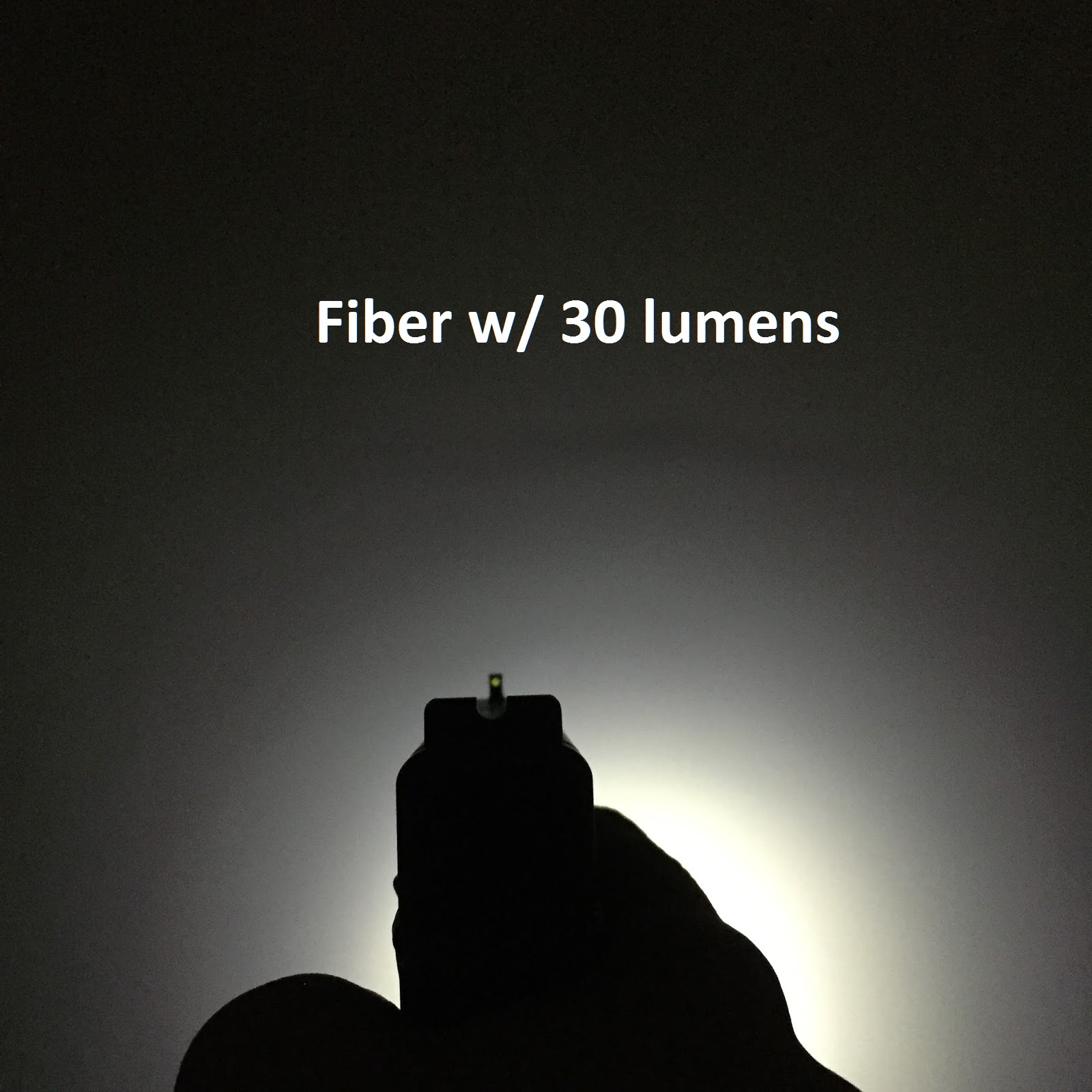
While some may question the durability of FO sights.  A proper holster completely covers and protects the front sight.  In the worse case scenario, the rod is covered by mud/blood, or breaks, leaving you with basically a black post.  The upper portion of the blade could be dented, collapsed, or broken off at the hole, but there are usually 2 to 4 of them.  Even if they all broke off, I'd still have the lower portion of the sight to work with. At typical defensive ranges well under 25 feet, I'm confident in my ability to get hits.  Besides, they can't be less durable than the factory plastic sights.  Fiber optic rods are cheap and easily replaced with a nail clipper and lighter.  They are much brighter in daylight and are as visible as tritium in low light.  Only when it's almost too dark to ID your target do tritium lamps have the advantage.  With a weapon or handheld light (I always have a handheld light when I carry), both effectively become black sights anyways.  For these reasons I don't think tritium sights offer much advantage in low light shooting.  They're not worse though, and I probably wouldn't replace tritium if they came on the gun.  In a few years when they start to dim however...
FNX 45 - Daylight


FNX 45 - Sights in Darkness

FNX 45 - Sights w/ 30 lumens

FNX 45 - Sights w/ 100 lumens

Glock 26 - 10-8 F/O Front w/ 30 lumens

Glock 26 - 10-8 F/O Front w/ 100 lumens

As I write this, I have a Trijicon RMR on the way.  I recently purchased a Glock 19 MOS to mount my Fastfire III red dot to try it out.  While I'm still retraining my brain to focus on the target, I can definitely see an advantage in the red dot.  Enough to plunk down the money for an RM07.  If I could find one I would have just bought a Unity Atom slide but that costs as much as a new G19.  Plus with 2 guns I can John Woo to my hearts content.  Now where can I find a dozen white doves?

-Carry On